
The Science
An old roof isn’t dying. It’s drying.
Asphalt shingles are held together by oils. The sun bakes those oils out until the shingle goes brittle and starts shedding the granules that protect everything underneath. Peak 301® puts the oil back. Here is what that actually does, and what an independent lab measured when they tested it.
Why shingles fail
Shingles don’t wear out. They dry out.
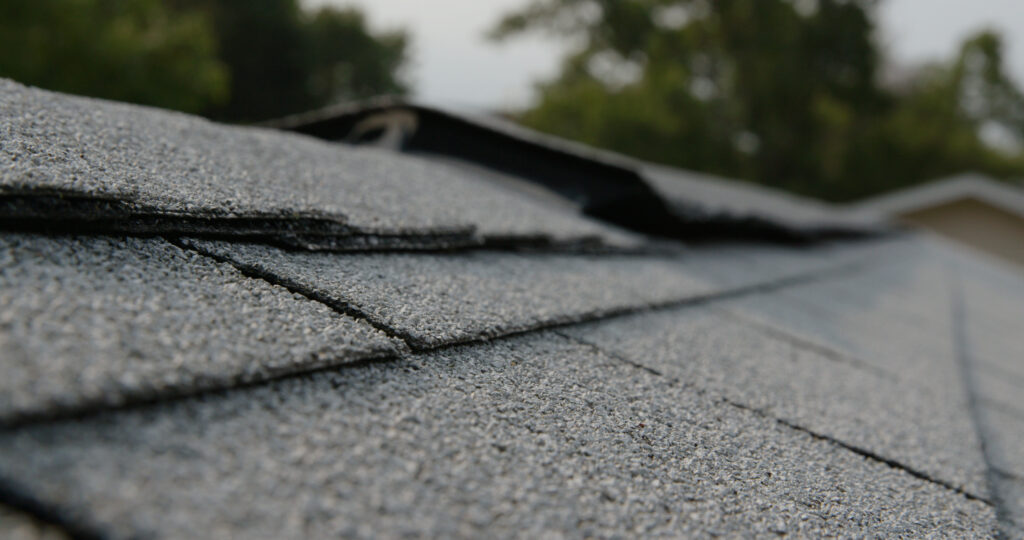
An asphalt shingle is a mat saturated with asphalt and topped with ceramic granules. The asphalt is what makes it flexible and waterproof, and it stays that way because of the oils inside it.
Heat and UV drive those oils out. As they go, the asphalt stiffens. A stiff shingle can’t hold its granules, so they wash into the gutter, which exposes more asphalt to the sun, which dries it faster. Then come the symptoms a homeowner recognizes: curling edges, cracks, bald patches, grit in the downspout.
That is the window Peak 301 works in. A roof that is drying still has a mat worth saving. A roof that has already lost its granules down to the mat, or that leaks, does not — and no treatment changes that.
How it works
Four things happen on the roof.
One visit, one crew, one to two hours on a typical roof. No tear-off, no dumpster, nobody moving out for the day.
1
It goes on as a spray.
One part concentrate to two parts water, applied evenly across the roof. A gallon of mixed product covers about 200 square feet.
2
It soaks in.
This is the part that matters. Peak 301 penetrates the shingle and works from the inside, rather than forming a film that sits on top and later wears off.
3
The asphalt softens again.
Replacing the oils the sun drove off restores flexibility to the binder holding the shingle together. In lab testing, treated shingles stayed pliable at lower temperatures than untreated ones.
4
The granules stay put.
A shingle that flexes holds its granule layer, and that layer is the roof’s first line of defense. This is where the biggest measured difference shows up.
Independent testing
What a third-party lab measured.
Peak 301 was tested by PRI Asphalt Technologies, an ISO/IEC 17025 accredited laboratory, on ten-year-aged asphalt shingles. These are the figures we stand behind.
86%
less granule loss than untreated shingles — 7.5× better retention.
~20%
or more stronger tear resistance after treatment.
44″→14″
fire spread in PRI burn testing — 68% less than untreated.
Pass
on hail-impact resistance, where a competing product failed.
Colder
temperatures before treated shingles lose pliability.
Minimal
color change — not noticeable under normal viewing.
Figures derived from PRI Asphalt Technologies testing on ten-year-aged asphalt shingles. Peak 301® is a rejuvenator, not a coating, sealant or paint.
Straight talk
What Peak 301® is not.
Knowing which roofs don’t qualify is what makes the ones that do an easy sell. Say this plainly and you’ll win more work, not less.
- It is not a coating, a sealant or paint. It penetrates and restores the shingle rather than forming a layer on top.
- It does not fix leaks or structural damage. Those are roofing repairs, and they come first.
- It will not save a failed roof. On the Granule Loss Scale, Levels 1–3 qualify, Level 4 is case by case, and Levels 5–6 need replacing.
- It does not restore or preserve a shingle manufacturer’s warranty or any UL fire rating. What it carries is its own: a six-year material warranty from Colorbiotics that transfers with the property.
Safe by design
Nothing you’d worry about spraying near a garden.
- All-natural, non-toxic, no odor. Safe for people, pets and plants.
- USDA Certified Biobased Product, 96%.
- Contains no soy methyl ester.
- Developed at Iowa State University. Made by Colorbiotics, a Sika company, from American-grown soybeans.
- Six-year manufacturer’s material warranty, transfers with the property.

Sell a roof you can stand behind.
Add Peak 301® to what you already sell. Start as a Referral Partner at no cost, or claim a territory.